Michio Ihara, sculptor,sculpture, matal, stainless steel, brass, gold, aluze, wind sculpture, architecture, plaza, public art, hotel, hospital, arena, airport, station, landscape, public art, institutions art, corporate art,
                                            Blue 4 -


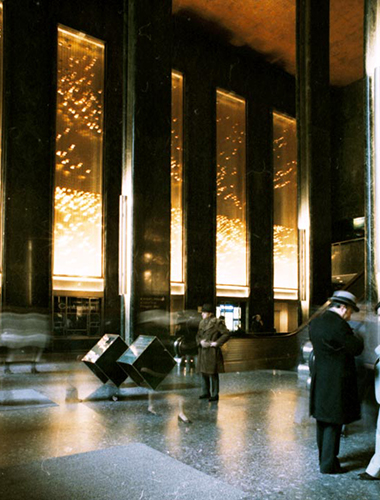
Rockefeller Center  New York, NY
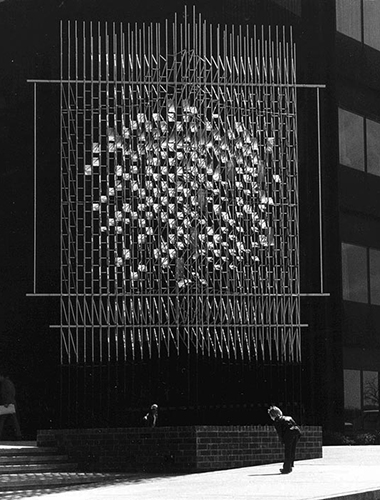
      Wellesley Office Park, Wellesley, MA
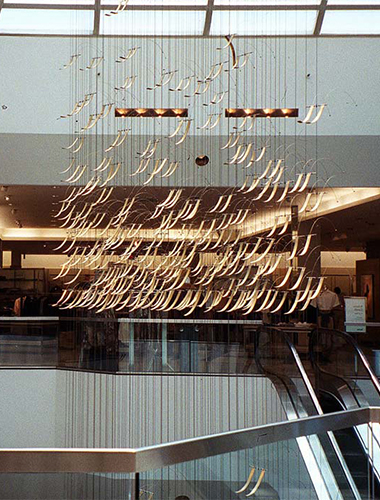
  Neiman-Marcus Store, Beverely Hills, CA


Artist Statement
CONTENTS
List of Commissions
 Sculpture Photographs

Artist Biography

On IHARA by Gyorgy Kepes
Early Drawings
 
IHARA by George Staempfli


Contact the Artist


Please be patient during loading, it might takes a little bit of time

This site is under construction / You may enter        /      このサイトは工事中ですどうぞ      /      2008


63 Wood Street, Concord, MA 01742-2225 U.S.A.
voice: 978-369-3731
 fax:   978-371-0482

e-mail michio.ihara@sprintmail.com


This URL: www.MichioIhara.com


This website is a record of work I have done over a period of about fifty years, devoting myself to production of sculpture for architectural and public spaces.  I am still actively pursuing such projects.  I hope viewers will find this work of interest and that architects, planners, and developers will contact me through this site
.
 
                                     
                                                                                                              Michio Ihara


Michio Ihara - His Works and Thoughts by Gyorgy Kepes

    It is a welcome privilege to comment on the work of my friend, Michio Ihara, the sculptor.  According to a well-known optical phenomenon, each angle of vision has its own optical projection, its own perspective. A visual image of a physical object seen close up appears larger and clearer than it does from far away. Perspective depends upon the viewer’s position in relation to the object seen. The estimation of creative person and his work has its own perspective - it depends upon the angle of vision of the viewer, his human position in relation to the observed.  My old friendship with Ihara, my closeness to his sprit, I believe gave me a clearer sharper view, which increased my estimation of him and his work.  I believe that my understanding of Michio Ihara’s creative value gained through the long years of friendship and collaboration.
    Ihara is fortunate artist.  Circumstances brought to him a confluence of the best qualities of two different cultures.  His unfailing sensibility stems from his Japanese background, as does his impressive mastery of the craft he applies to form his work.  His disciplined clear awareness of the artistic means and goals given by our complex industrial society was developed during his contact with the problems of the scientific technology of a most powerful Western industrial nation.
    It is recognized that the strongest growth, the most potent events, emerges at the boundary of different energy levels. Creative vitality is most vigorous when inherited values, attitudes new perspectives and new potentials meet each other.  Nineteen century science considered “interbreeding” fundamental to the improvement of species, and thus and fundamental to evolutionary progress.          Today we begin to recognize that in this complex interdependent total of twentieth century scientific technology, ”interthinking” the confluence of knowledge, social outlook, aspirations, and artistic sensibilities appear to be the best guarantee to the security and enrichment of our contemporary life.  Michio Ihara’s sensibility, creative intelligence, and imaginative power made the best use of his heritage and the dynamic horizon of his environment.
    Ihara became a ‘builder” in deepest and most fundamental meaning of the world.  He constructs his sculptures with precision and innovating insights.  He respects, recognizes and utilizes a significant contemporary construction method; he builds his sculptures from modules.  His artistic forms are imaginative explorations of modular coordination.  Modular coordination in its aspect of standardized products and manufactured processes is inherent in the condition of our time.  To live up to twentieth century material standards our productive economy has taken the dynamic direction of continuous expansion through.


Mass production; its great need is to produce the greatest quantity with the greatest economy of means. There is an increasing tendency to produce standard units, which could interlock with he greatest combinatory possibilities.  Radio sets are made with standardized tube and components, buildings are assembled from prefabricated members, machines have interchangeable parts.  Buildings, bridges, motorcars, have endowed the modular relation with vital importance in human thought and activity.  The new building concepts have to find their poetic projections - modular combinations, their artistic equivalent. Ihara recognized these needs.  His structures are as contemporary as a television tower or as a supporting pylon of high power wires, His lace-like space textures in spite of their shimmering, elusive lightness, achieve clarity and impressive stability.  Although these fluid, vibrating, transparent, free texture fields are afloat with impressive freedom in space, they always have a clearly legible spatial coherence.  They are architectonic in the most fundamental true meaning of the word.
    Due to their intrinsic architectural quality, Ihara’s works retain their convincing artistic strength in whatever scale they may appear; and for the same reason - his vibrating space forms fit comfortably within any truly contemporary architectural surroundings.  Ihara is not weighted down by soul-searching explorations.  His work is not disturbed by aggressive, ego-bragging ambition.  They do not mimic robust minimal forms.  His forms are not restrained to be lean or taut, but willing and able to dance with refreshing freedom and vibrate and sparkle as the pure water of a mountain brook in sunlight.
    His work is enriching many important public buildings and places. They are in Tokyo, in Auckland, in New York, in Boston, in Baltimore and other corners of the world.  Where they may be, his poetic space textures are friendly oases, place of repose, in the cold, brutal, sometimes hopeless settings of our not yet resolved cities.  Though they are not made with conscious mathematical discipline, their inherent clarity is based upon the logic of their making - they radiate purity, clarity and confidence.


Gyorgy Kepes
Director Emeritus
Center of Advanced Visual Studies
Massachusetts Institute of Technology
Cambridge, Massachusetts

                                                                                                    from the Japan Interior Design, 1978


Michio Ihara


    Michio Ihara works with stainless steel, with brass and copper, but mainly he works with space. His large sculptures, carefully organized and proportioned, are condensation of their surrounding space  Air and light freely flow through their transparent structure and thus become an integral part of it.  Clusters of small shiny parts vibrate with the currents of air, and create an image of living and breathing forms.  As a result, Ihara’s sculptures seems almost weightless, as if they were merely a pattern of light beams, or a cascade of glittering reflections.

    An important component in the appearance of these sculptures is created by the changing densities of the structures.  Open areas which reach out to gather space with a fine net of metal lines are interspersed with condensed groups of paralled rods which seem to restrict and compress the space they surround.  Occasional moving accents of reflected light furnish exciting contrasts with the elegantly designed basic body of the sculpture.

    Ihara was born in Paris and educated in Japan.  His refined taste reflects that persistent Japanese craving for the cleanest possible design, for the simplest possible functional form of any given object.

    Another factor which guides Ihara’s work has to do with its affinity to the architectural environment.  Many of his best and most imaginative sculpture were actually commissioned for given locations in new buildings.  He has been able to work closely with the architects involved, and has successfully interpreted their ideas in his work which enhance the architectural details and which express a happy understanding between himself and the architect.  There are a great number of such examples of sensitive cooperation illustrated in this volume.  It is not surprising that Ihara is being called on again and again to add an important and essential element of beauty to the functional plans of the architect.


                                                               George W. Staempfli    STAEMPFLI  GALLERY,    New York

                                                                                                                                                                                                                                                                                                                  from the Staempfli Gallery show catalog, 1984


Click thumbnail image for larger photo and detailed information


1
1982
1984
1963
1974
1969
1966
1999
1982
2002
1977


2
2002
1973
1978
1991
1990
1995
1991
1994
1979
1986


3
2004
1998
1997
1976
2000
1997
1982
1997
1994
2002


4
1989
2000
2003
1997
1991
2001
1971
2002
1997
1978


5


1966
1980
1977
1985
1990
1999
1991
1979
1982
1984


6

1967
1977
1978
1966
1985
1989
1996
1993
1966
1992


7

1963
1970
1977
1969
1970
1959
1984
1965
1999
1989


8
1970
1962
1963
1965
1970
1957
1985
1984
1980
1965


9

2000
1999
1999
2004
2005
2006
2007
2007
2008
2008


10
2008
2008